
Need assistance with our tools or job circular? Contact our editorial team or explore our FAQs for quick support.

Resignation Letter Generator
DIGESTPRESS CAREER UTILITY
Professional Resignation Letter Generator
Create a polite, professional, and formal resignation notice in seconds with instant live preview.
DigestPress Career Tools
Write Your Resignation Letter Clearly
Organise your employment details and prepare a respectful, professional resignation notice.
Resignation Letter Generator: Create a Professional Resignation Letter
Leaving a job is an important career decision, and the way you communicate it can affect your professional relationship with your employer. A resignation letter should state your intention clearly, identify your expected last working day and maintain a respectful tone.
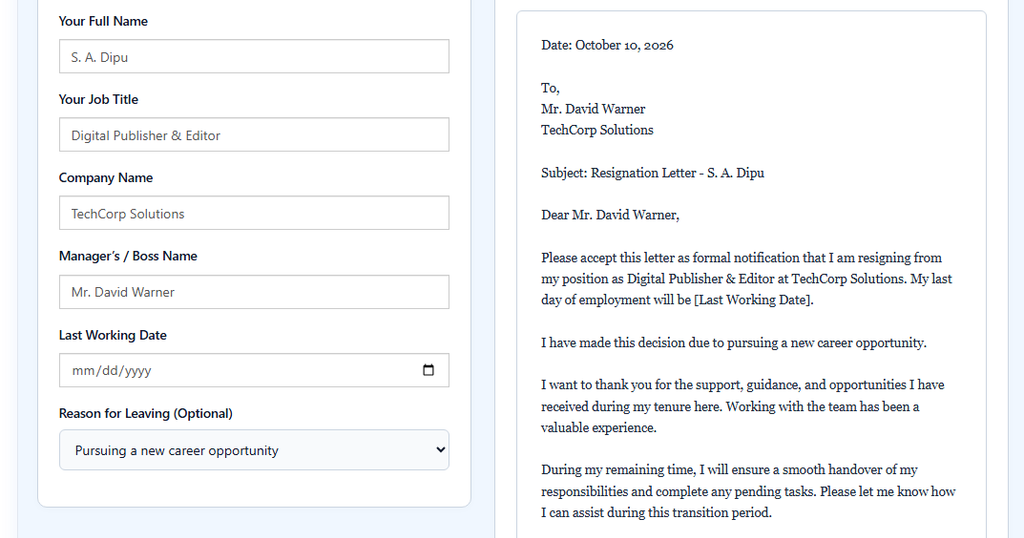
The DigestPress Resignation Letter Generator helps you organise the key details needed for a formal resignation notice. Enter your employment information, review the resulting letter and use the copy option to transfer the text into a document or email for final editing.
What Is a Resignation Letter?
A resignation letter is a written notice informing an employer that you intend to leave your position. Depending on your workplace policy and employment agreement, it may be submitted to your manager, human resources department or another designated contact.
A clear letter usually identifies the employee, position, organisation and intended final working date. A brief expression of appreciation and an offer to support the handover may also be appropriate. You generally do not need to include a lengthy explanation of your personal circumstances.
How to Use the DigestPress Resignation Letter Generator
1. Enter your name and job title
Fill in the Your Full Name and Your Job Title fields. Use the name and designation that match your employment records so the letter can be identified correctly.
2. Add the company and manager details
Enter the Company Name and Manager’s / Boss Name. Check spelling and job titles before proceeding. If your organisation requires the letter to be addressed to HR or another official, follow its submission instructions.
3. Confirm your last working date
Choose the Last Working Date carefully. Before entering it, review your employment contract, applicable workplace policy and any notice-period requirements relevant to your situation.
Do not assume that every employee has the same notice period. If the date is uncertain or your contract is unclear, confirm the requirements with HR or an appropriate adviser before submitting your letter.
4. Select a reason only if appropriate
The generator includes an optional Reason for Leaving field. You do not need to provide personal details simply because an optional field is available. Keep the explanation concise and professional if you decide to include one.
5. Copy and review the letter
Use the Copy Resignation Letter button to copy the generated text. Read the entire letter before sending it. Check the recipient, company name, job title, final working date, tone and any other details the generated draft contains.
What Should a Professional Resignation Letter Include?
A resignation letter does not need to be long to be effective. These components can help keep it clear and useful.
A clear statement of resignation
State directly that you are resigning from your position. Avoid wording that makes your intention or the purpose of the letter unclear.
Your position and employer
Identify your job title and organisation so the recipient can understand which role the notice concerns.
The proposed last working day
Include the date you intend to leave, provided it is consistent with your notice requirements or has been confirmed with the employer. If the date needs approval, make that clear rather than presenting an unconfirmed date as final.
A professional closing
Where appropriate, thank your employer for the opportunity and offer reasonable assistance with the transition. Keep the tone neutral, even if you are leaving because of a difficult workplace experience.
Resignation Letter Example
You can use this general example as a starting point and adapt it to your circumstances.
Subject: Resignation from [Job Title]
Dear [Manager’s Name],
Please accept this letter as formal notice of my resignation from my position as [Job Title] at [Company Name]. My proposed last working day is [Date], subject to the applicable notice requirements and confirmation where necessary.
Thank you for the opportunities and experience I have gained during my time with the organisation. I will do my best to support a smooth handover of my current responsibilities during the remaining period.
Sincerely,
[Your Full Name]
This is a general template, not a substitute for an employer-specific form or contractual requirement. Adjust the wording and date before sending it.
Common Resignation Letter Mistakes to Avoid
- Using an unconfirmed final date: Check the notice period and any approval requirements before submitting the letter.
- Including unnecessary personal details: Keep the letter focused on the resignation and essential administrative information.
- Writing in anger: Avoid accusations, insults or emotional statements that do not belong in a formal notice.
- Forgetting to check the recipient: Confirm whether the letter should go to your manager, HR or another designated person.
- Sending the first draft without reviewing it: Check names, dates, formatting and contact details before sending.
- Assuming a copied draft is automatically ready: A generated letter is a starting point. You remain responsible for confirming that it reflects your actual situation.
Before You Submit Your Resignation
Use this final review to help avoid preventable errors:
- Confirm your employment terms and notice requirements.
- Verify your intended last working day.
- Check the recipient’s name and designation.
- Review the complete letter for accuracy and tone.
- Follow your organisation’s required submission method.
- Keep a copy of the final letter and any acknowledgement, where appropriate.
If you have questions about contractual obligations, unpaid benefits or a disputed notice period, seek guidance from HR or a qualified professional familiar with the applicable rules.
Prepare for Your Next Career Step
A resignation is often followed by another career decision. If you are preparing to apply for a new role, the DigestPress Online CV Builder can help you organise your professional history, while the Cover Letter Generator can help you prepare a role-specific application letter.
You can also use the Job Application Checklist to review key tasks before submitting an application.
The DigestPress Resignation Letter Generator can help you organise a formal notice, but the final letter should always reflect your employment terms, your confirmed dates and your own circumstances. Review the copied text carefully before sending it to your employer.
Prepare Your Resignation Letter
Enter your details, review the draft and check your notice requirements before submitting it.