
Need assistance with our tools or job circular? Contact our editorial team or explore our FAQs for quick support.

Cover Letter Generator
CAREER UTILITY TOOL
Interactive Cover Letter Generator
Create, customize, and export professional, ATS-ready cover letters instantly with real-time document preview.
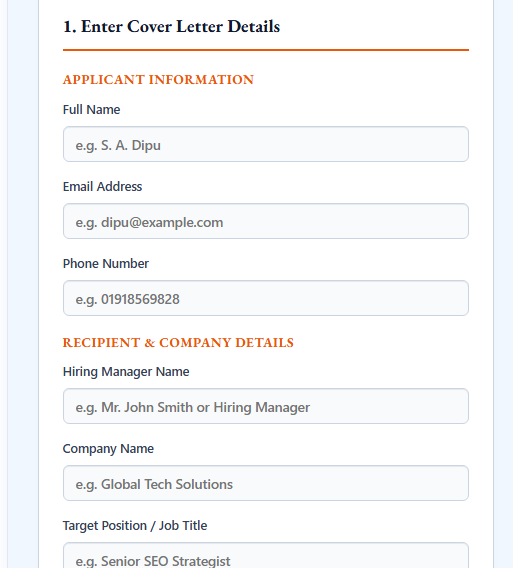
1. Enter Cover Letter Details
Applicant Information
Recipient & Company Details
Letter Body Content
*Clicking download will open the print dialog. Select “Save as PDF”.
2. Live Document Preview
Your Name
email@example.com |
Phone Number
Date: October 10, 2026
Hiring Manager
Company Name
Dear Hiring Manager,
Your cover letter body content will appear here in professional formatting…
Sincerely,
Your Name
DigestPress Career Tool
Make Your Job Application More Personal
Organize your relevant skills, experience and motivation into a clear cover letter.
Cover Letter Generator: Prepare a More Focused Job Application
A CV outlines your qualifications, experience and skills. A cover letter adds context: it explains why you are applying for a particular position and which parts of your background make you a relevant candidate.
Writing a separate letter for every vacancy can be time-consuming, particularly when you are applying for several roles. A Cover Letter Generator can help you get started with a structured draft that you can review and adapt to the employer, position and your own experience.
The DigestPress Cover Letter Generator is designed for people preparing job applications. Use the tool to support your writing process, then check the final letter carefully before submitting it.
What Makes a Cover Letter Useful?
A strong cover letter does more than repeat a CV. It connects selected qualifications and achievements to the position you want.
For example, a candidate applying for a customer service role might highlight experience resolving customer issues, communicating clearly and managing enquiries. Someone applying for a junior accounting position might emphasize relevant academic training, spreadsheet skills and experience handling financial records.
The details should come from your actual background. A persuasive letter does not need exaggerated claims; it needs relevant evidence presented clearly.
How to Prepare a Cover Letter with DigestPress
Open the Cover Letter Generator and follow the instructions shown on the current page. The exact fields and available output options should be checked directly in the live tool before publication.
Step 1: Identify the Position
Start with the exact job title and employer information required by the tool. Use the vacancy announcement to confirm the role’s name and the organization’s correct spelling.
If the employer identifies a hiring manager or recruiter, use that person’s name when appropriate. Otherwise, a professional general greeting is usually preferable to guessing a name.
Step 2: Choose Relevant Experience and Skills
Identify two or three qualifications, skills or accomplishments that relate directly to the job description. Select evidence that helps explain what you could contribute.
Avoid vague claims such as “I am the best candidate” unless you can replace them with meaningful evidence. A specific example of a task you handled or a skill you used is more informative than a list of unsupported adjectives.
Step 3: Explain Why You Want the Role
A cover letter should show that you understand what you are applying for. Mention a relevant responsibility, the type of work involved or a genuine reason the role fits your professional direction.
Do not invent knowledge of a company, its culture or its projects. If you mention an organizational achievement or initiative, verify the information first.
Step 4: Review and Personalize the Draft
Treat any generated or template-based text as a starting point, not an automatically finished application. Check that the letter reflects your own experience, sounds natural and addresses the actual vacancy.
Remove statements that could apply to almost any applicant. Correct inaccurate dates, job titles, qualifications and company details before using the letter.
What Should a Professional Cover Letter Include?
Most job application letters can be organized into a few clear parts. The exact format may vary depending on the employer’s instructions and the way the application is submitted.
| Section | What to include |
|---|---|
| Contact details | Your relevant contact information, where required |
| Greeting | The hiring manager’s name or a suitable professional greeting |
| Opening | The position you are applying for and a concise introduction |
| Relevant evidence | Skills, experience or achievements related to the role |
| Motivation | A genuine explanation of your interest in the position |
| Closing | A polite closing that expresses interest in discussing your application |
Keep the letter focused. The purpose is not to reproduce every detail from your CV but to help the employer understand why the most relevant details matter.
Cover Letter Examples: How to Make the Message Specific
Consider the difference between a broad statement and a more informative one.
Generic: “I am hardworking and have excellent communication skills.”
More specific: “In my previous customer-facing work, I regularly explained service options to customers and helped resolve their enquiries.”
The second statement describes an activity that an employer can better understand. Use it only if it accurately reflects your experience.
For a fresh graduate, relevant academic projects, internships, volunteering or practical coursework may provide useful evidence. You do not need to pretend to have years of professional experience. Instead, show how your existing skills relate to the responsibilities of the position.
Check the Final Letter Before Sending It
A well-structured draft can still contain mistakes. Before submitting your application, check these points:
- Job title: Does it match the vacancy?
- Employer details: Are the organization and recipient names correct?
- Relevance: Does the letter explain your fit for this specific role?
- Accuracy: Can you support every claim about your experience and qualifications?
- Readability: Are paragraphs short, clear and easy to follow?
- Length: Does the letter follow the employer’s instructions?
- File format: If you are submitting a document, does it meet the requested format?
If the employer requests a short email rather than an attached letter, adapt the content accordingly. A formal document and an application email serve related but different purposes.
- Title: Reviewing a Cover Letter Before Submission
- Alt Text: DigestPress Cover Letter Generator showing the letter preparation or output area, as displayed on the live page.
- Description: A screenshot of the actual tool’s draft, preview or result area, if available. Place it beside the final-review guidance to show readers where they can inspect the prepared letter before using it. If the live tool does not include a preview or result panel, capture the actual final writing area instead and describe it accurately.
- Caption: Check the wording, job details and accuracy of your letter before submitting your application.
Use the Cover Letter Alongside Your CV
Your cover letter and CV should support each other without repeating the same information line by line. The CV provides a broader record of your background; the letter highlights the experience and motivation most relevant to a particular opportunity.
Use the DigestPress Online CV Builder if you also need to organize your professional summary, work experience, education and skills into a CV.
Before submitting the application, review the employer’s required documents and use a Job Application Checklist to help you check that the necessary materials are ready.
Common Questions About Cover Letters
What is a cover letter generator?
A cover letter generator is an online tool that helps users prepare a job application letter using the information and options available in the tool. The resulting draft should be reviewed and tailored before submission.
Should I send the same cover letter for every job?
It is better to adapt the letter to each position. The opening, relevant skills and supporting examples should reflect the requirements of the specific vacancy.
Can a fresh graduate write a strong cover letter?
Yes. Fresh graduates can highlight relevant coursework, projects, internships, volunteering, transferable skills and their reasons for applying. Claims should remain accurate and proportionate to their experience.
Does a generated cover letter guarantee an interview?
No. A cover letter is only one part of an application. Hiring decisions depend on the employer’s requirements, the applicant’s qualifications and other factors outside the tool’s control.
Should I check the letter after generating it?
Yes. Verify the job title, employer details, spelling, qualifications and all factual claims. Make sure the wording reflects your own background and follows the employer’s submission instructions.
Prepare Your Next Job Application with Care
A cover letter is most useful when it connects your real experience to the role you want. Use the DigestPress Cover Letter Generator as a starting point, refine the wording and confirm every detail before sending it. A focused, accurate letter gives the employer a clearer explanation of your interest and relevant strengths.
Give Your Job Application a Clearer Voice
Prepare a focused cover letter, review the details and tailor it to your target role.