
Salary Calculator
Convert your pay between hourly, daily, weekly, monthly and yearly rates — and build your monthly gross and net salary from allowances and deductions. Everything is calculated in your browser; nothing is sent anywhere.
Convert your pay
| Period | Amount |
|---|---|
| Hourly | — |
| Daily | — |
| Weekly | — |
| Monthly | — |
| Yearly | — |
Yearly pay assumes 52 working weeks. Monthly pay is the yearly amount divided by 12.
Build your monthly salary
Fill in the parts of your monthly pay to see the gross and net totals. Leave any field empty or zero if it does not apply to you.
This is an estimate from the numbers you enter. Your actual payslip may differ — tax rules and provident fund rates vary by country and employer.
How to convert your pay
Job offers rarely use the same numbers. One employer offers $25 an hour, another offers $4,500 a month, a third offers $55,000 a year. To compare them fairly you need every offer in the same unit — and that is what the converter above does. Type any amount, pick its period, and the table shows the matching hourly, daily, weekly, monthly and yearly figures at once.
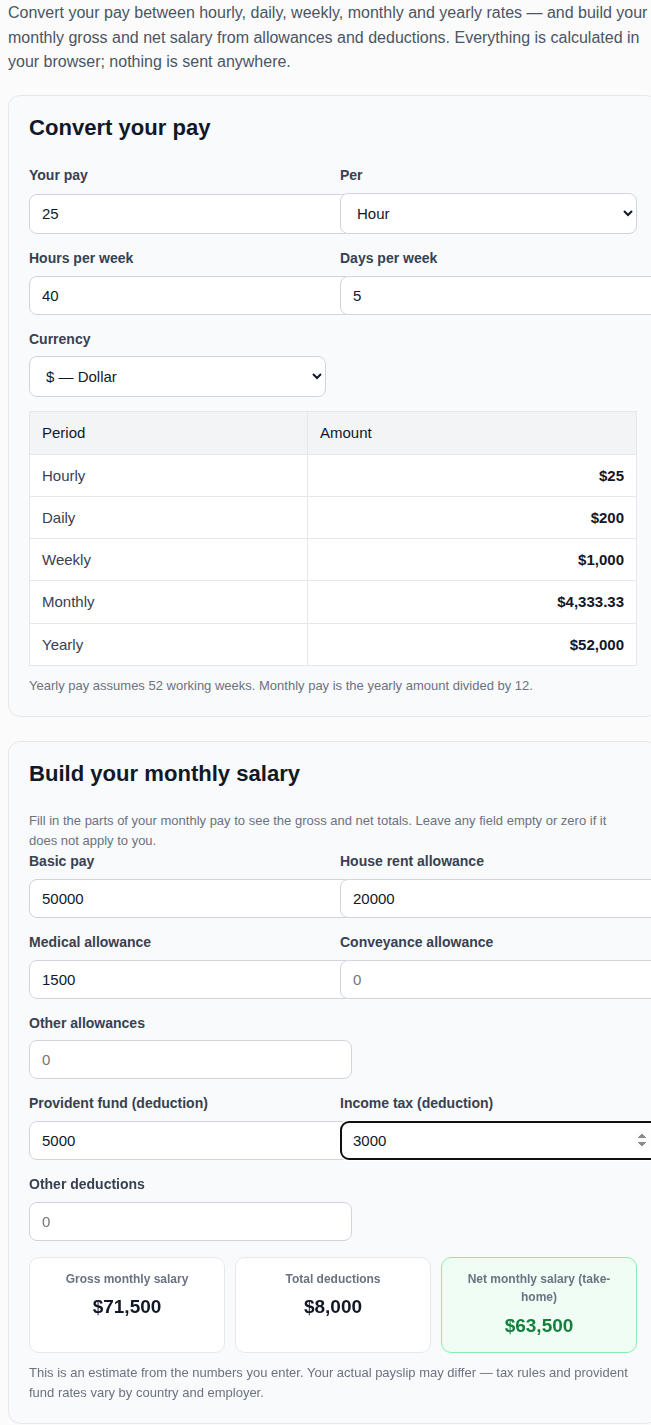
The conversion uses your real working pattern. A year counts as 52 working weeks, and a month is the yearly amount divided by 12. If you work 40 hours a week over 5 days, $25 an hour means $1,000 a week, $4,333 a month and $52,000 a year. Change the hours or days per week and every figure updates — part-time and shift workers get exact numbers for their own schedule.
Hourly, monthly or yearly — which number matters?
It depends on how you are paid. Hourly workers should check the yearly figure before accepting a job: a small hourly difference becomes thousands over a year. Salaried workers should check the hourly figure: a $60,000 salary over a 40-hour week is about $29 an hour, but over a 55-hour week it is only about $21 an hour. The converter makes both views visible in one place.
| Hourly (40 h/week) | Weekly | Monthly | Yearly |
|---|---|---|---|
| $10 | $400 | $1,733 | $20,800 |
| $15 | $600 | $2,600 | $31,200 |
| $25 | $1,000 | $4,333 | $52,000 |
| $50 | $2,000 | $8,667 | $104,000 |
Gross vs net salary — what is the difference?
Gross salary is everything your employer pays you before anything is taken off: basic pay plus all allowances. Net salary — the take-home pay — is what actually reaches your bank account after deductions such as provident fund contributions, income tax and any other deductions. The two numbers can be far apart, which is why the second calculator above builds both from your own figures instead of guessing.
What makes up a monthly salary?
A typical monthly payslip has two sides. On the earnings side: basic pay, house rent allowance, medical allowance, conveyance allowance and any other allowances. On the deductions side: provident fund, income tax and other deductions. Add the earnings for the gross, subtract the deductions for the net. Fill in only the parts that apply to you — anything left blank counts as zero.
Frequently asked questions
How is monthly salary calculated from an hourly rate?
Multiply the hourly rate by the hours you work each week, then by 52 weeks, then divide by 12. So $25 an hour at 40 hours a week is $25 × 40 × 52 ÷ 12 = $4,333 a month.
How many working hours are there in a month?
At 40 hours a week, a month averages about 173.33 working hours (40 × 52 ÷ 12). Some months have more working days than others, which is why the yearly figure divided by 12 is the fairest monthly number.
Does overtime count in this calculator?
No. Overtime pay varies too much — different rates, different rules — to fold into a single formula. Work out your overtime separately and add it to the monthly figure.
Is the result exact?
It is exact for the numbers you enter, but it is still an estimate of your real payslip. Tax rules, provident fund rates and allowance rules vary by country and employer, so always check the final figures against your offer letter or payslip.