
IELTS Band Calculator
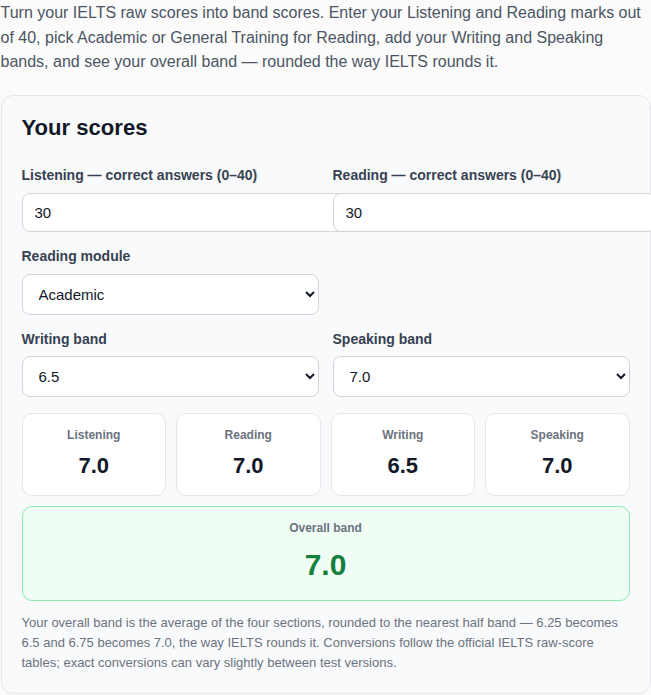
Turn your IELTS raw scores into band scores. Enter your Listening and Reading marks out of 40, pick Academic or General Training for Reading, add your Writing and Speaking bands, and see your overall band — rounded the way IELTS rounds it.
Your scores
Your overall band is the average of the four sections, rounded to the nearest half band — 6.25 becomes 6.5 and 6.75 becomes 7.0, the way IELTS rounds it. Conversions follow the official IELTS raw-score tables; exact conversions can vary slightly between test versions.
How to calculate your IELTS band score
Enter your Listening and Reading marks — how many answers you got right out of 40 — and pick your Reading module, Academic or General Training. Then select your Writing and Speaking bands. The calculator converts each raw score to its band using the official IELTS tables and works out your overall band the way IELTS does: the average of the four sections, rounded to the nearest half band.
How raw scores become band scores
Listening and Reading are marked out of 40, but your band is not a simple percentage. Each raw score maps to a band on a fixed table — and the Reading table is different for Academic and General Training, because the GT reading passages are easier. The same raw score can mean a different band: 30 correct in Academic Reading is band 7, but 30 correct in General Training Reading is band 6. That is why the module selector matters.
| Correct (out of 40) | Listening | Reading Academic | Reading General |
|---|---|---|---|
| 39–40 | 9.0 | 9.0 | 9.0 (40 only) |
| 35–36 | 8.0 | 8.0 | 7.0–7.5 |
| 30–31 | 7.0 | 7.0 | 6.0 |
| 26–29 | 6.5 | 6.0–6.5 | 5.0–5.5 |
| 23–25 | 6.0 | 6.0 | 5.0 |
| 18–22 | 5.5 | 5.0–5.5 | 4.0–4.5 |
How the overall band is rounded
Your overall band is the mean of your four section bands, rounded to the nearest half band. If the average ends in .25, it rounds up to the next half band; if it ends in .75, it rounds up to the next whole band. So an average of 6.25 becomes 6.5, and an average of 6.75 becomes 7.0. An average of 6.125 becomes 6.0. Half a band can decide a university offer, so the rounding is worth understanding.
What the bands mean
Band 9 is an expert user, 8 very good, 7 good, 6 competent, 5 modest, 4 limited. Most universities ask for 6.0 or 6.5 overall, often with no section below 5.5 or 6.0. Competitive programmes and professional registration can ask for 7.0 or higher. Always check the exact requirement — including any minimum per section — before you book your test.
Frequently asked questions
Is the Academic Reading table different from General Training?
Yes. General Training reading passages are easier, so you need more correct answers for the same band. For example, band 7 needs 30 correct in Academic Reading but 34 correct in General Training Reading.
How is the Writing band decided?
Writing is not a raw score. Two trained examiners mark your Task 1 and Task 2 against four criteria: task achievement, coherence and cohesion, lexical resource, and grammatical range and accuracy. Task 2 counts twice as much as Task 1. Enter the band from your practice test or your last result.
Can I retake one section?
In many countries IELTS now offers One Skill Retake: if you took IELTS on computer, you can retake a single section within 60 days of your original test. Availability and rules vary by test centre, so check with yours.
How accurate is this calculator?
The conversion tables are the official IELTS tables, and the rounding follows the official rule. Exact conversions can vary slightly between test versions, so treat the result as a very close estimate — your official Test Report Form is the final word.