
GPA Calculator
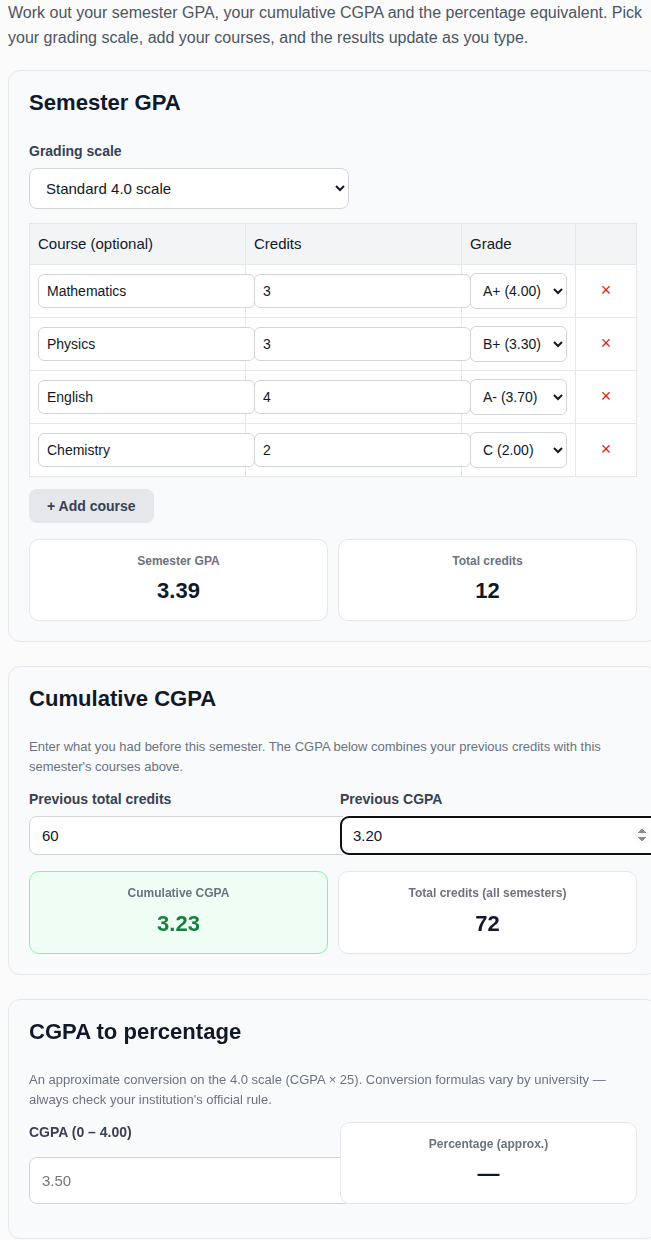
Work out your semester GPA, your cumulative CGPA and the percentage equivalent. Pick your grading scale, add your courses, and the results update as you type.
Semester GPA
| Course (optional) | Credits | Grade |
|---|
Cumulative CGPA
Enter what you had before this semester. The CGPA below combines your previous credits with this semester's courses above.
CGPA to percentage
An approximate conversion on the 4.0 scale (CGPA × 25). Conversion formulas vary by university — always check your institution's official rule.
How to calculate your GPA
Pick your grading scale first — the Standard 4.0 scale or the Bangladesh UGC scale, whichever your university uses. Then add each course with its credit hours and the grade you received, and your semester GPA appears at once. Enter your previous total credits and CGPA to see your cumulative CGPA, and use the converter to see the percentage equivalent of any CGPA.
How GPA is calculated
Your GPA is a weighted average: each grade is worth a number of grade points, and courses with more credits count more. The formula is GPA = (grade points × credits, added up for all courses) ÷ (total credits). For example, a 3-credit A (4.0) and a 3-credit B+ (3.3) give (3 × 4.0 + 3 × 3.3) ÷ 6 = 3.65. A failed course counts as 0 grade points but its credits still count in the total, which is why one F pulls your GPA down more than one A pulls it up.
| Grade | Standard 4.0 | Bangladesh UGC |
|---|---|---|
| A+ | 4.00 | 4.00 |
| A | 4.00 | 3.75 |
| A− | 3.70 | 3.50 |
| B+ | 3.30 | 3.25 |
| B | 3.00 | 3.00 |
| B− | 2.70 | 2.75 |
| C+ | 2.30 | 2.50 |
| C | 2.00 | 2.25 |
| C− | 1.70 | — |
| D+ | 1.30 | — |
| D | 1.00 | 2.00 |
| F | 0.00 | 0.00 |
GPA vs CGPA — what is the difference?
GPA covers one semester; CGPA (cumulative GPA) covers all your semesters so far. Your CGPA is the same weighted average taken over every course you have ever completed. That is why early semesters matter: a weak first year stays in your CGPA until you have enough later credits to balance it. The CGPA panel above combines your previous record with this semester so you can see where you stand.
CGPA to percentage
There is no single official formula for turning a CGPA into a percentage. The converter above uses CGPA × 25 on the 4.0 scale — so 3.50 becomes 87.5% — which is the most common approximation. Some universities and employers use their own formula, so always check the official rule of the institution asking for the percentage before you submit it.
Frequently asked questions
What is a good GPA?
On the 4.0 scale, 3.50 and above is generally considered strong and meets most scholarship cut-offs; 3.00 and above meets most graduate admission and job requirements. What counts as “good” depends on your field and your university — compare yourself with your own programme’s average, not with a random number online.
Can I raise my CGPA?
Yes, but slowly. Each new semester adds its credits to the total, so later semesters dilute earlier ones — the more credits you have already completed, the harder it is to move the average. Retaking a failed or low-graded course helps most where your university replaces the old grade.
Does an F count in my GPA?
Yes. An F earns 0 grade points, but its credits still count in the total credits you divide by. That is why a failed course lowers your GPA more than a good grade in the same course would raise it.
What if my university uses a different scale?
Pick the scale closest to yours — Standard 4.0 or Bangladesh UGC — and check the grade points in the table above against your student handbook. If your university’s points differ, the GPA will differ too; the formula stays the same.